Is Intermittent Fasting Good for Women Over 40? An Honest Answer
Affiliate Disclosure: This article contains affiliate links. If you buy through our links, we may earn a small commission at no extra cost to you. We only recommend products we’d stand behind.
⚡ Quick Answer
Intermittent fasting for women over 40 is not a simple yes or no. The evidence shows genuine benefits — improved insulin sensitivity, reduced inflammatory markers, better metabolic flexibility — alongside real, sex-specific risks: elevated cortisol, disrupted thyroid function, worsened perimenopausal symptoms, and muscle loss if protein intake is insufficient. This honest guide covers both sides of the intermittent fasting women 40 research, who it suits, who should be cautious, and how to do it safely if you decide to try.

What Intermittent Fasting for Women Over 40 Actually Means
Intermittent fasting for women over 40 refers to structured time-restricted eating — alternating periods of normal eating and deliberate fasting within a set daily or weekly schedule. Intermittent fasting is not a specific diet in terms of what you eat, but a structure for when you eat. The four main intermittent fasting protocols used by women over 40 are:
- 16:8 intermittent fasting: a 16-hour fasting window followed by an 8-hour eating window. Typically 12pm–8pm or 11am–7pm. The most popular intermittent fasting approach for women over 40 — but also the most aggressive in its demands on the HPA axis
- 14:10 intermittent fasting: 14 hours fasting, 10 hours eating. A gentler and more appropriate entry point for intermittent fasting women 40 — physiologically meaningful without the cortisol risks of longer fasts
- 12:12 intermittent fasting: 12 hours each. Eating 8am–8pm, for example. The least disruptive intermittent fasting protocol for women over 40 — essentially just avoiding late-night eating. Produces overnight fasting benefits without meaningful cortisol impact
- 5:2 intermittent fasting: five days of normal eating, two non-consecutive days of significantly reduced intake (500–600 calories). More research in general populations than specifically in intermittent fasting women 40
What intermittent fasting for women over 40 is not: starvation, severe calorie restriction, or a guarantee of weight loss. The mechanism of intermittent fasting is primarily about insulin regulation, metabolic flexibility, and cellular maintenance processes — not simply about eating fewer calories.
The Evidence: What Research Actually Shows About Intermittent Fasting for Women Over 40
Potential Benefits of Intermittent Fasting for Women Over 40
The research on intermittent fasting women 40 is still developing — much of the foundational fasting research was conducted in men or in animal models. However, the available evidence supports several genuine benefits:
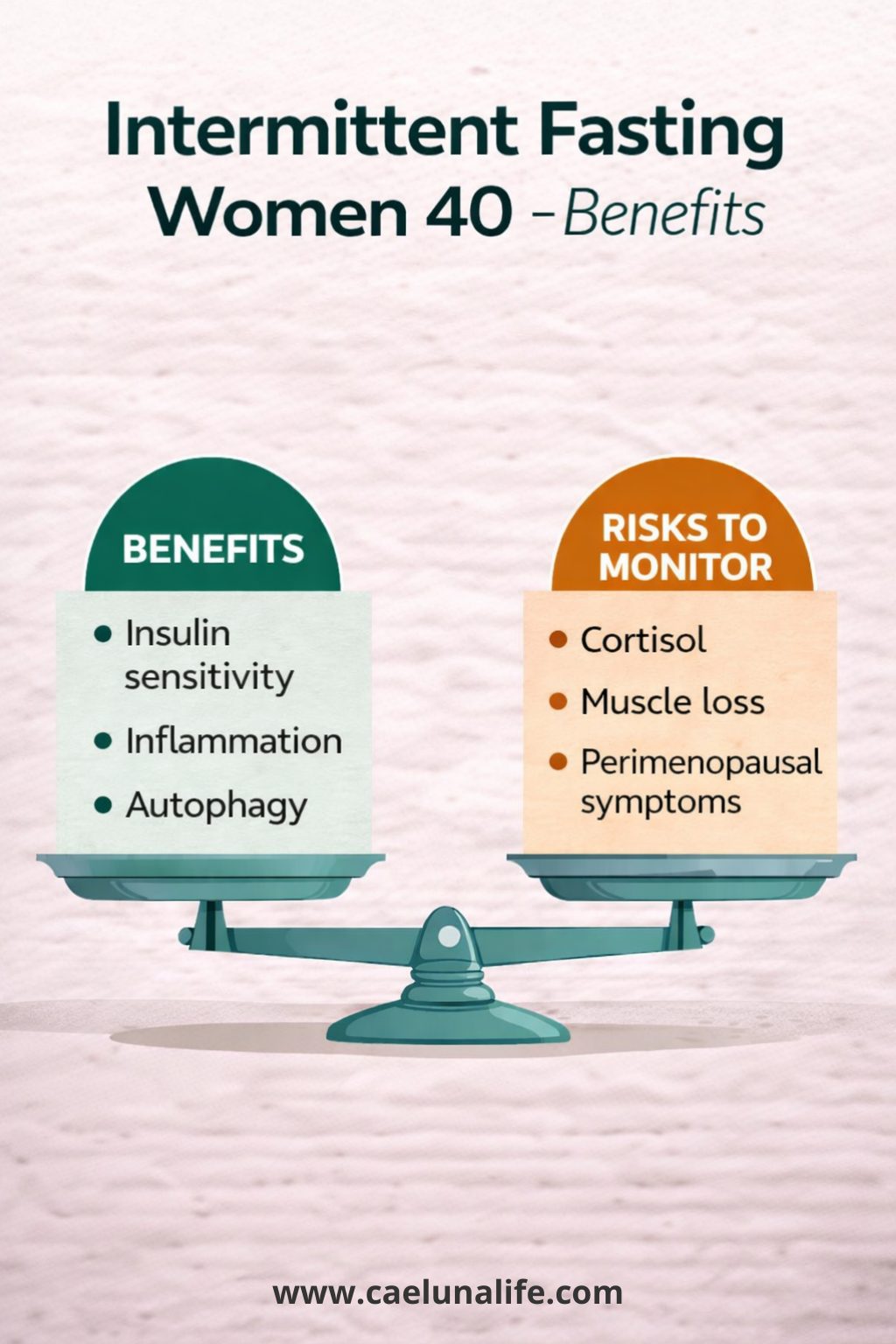
- Improved insulin sensitivity: intermittent fasting reduces fasting insulin levels and improves insulin sensitivity — particularly relevant for women over 40 whose insulin sensitivity naturally declines with oestrogen reduction. Multiple controlled trials show improvements in HOMA-IR (a measure of insulin resistance) with intermittent fasting women 40 protocols
- Reduced inflammatory markers: several studies show intermittent fasting reduces CRP and IL-6. A 2019 randomised trial found that 5 weeks of time-restricted eating reduced CRP by an average of 0.8 mg/L in pre-menopausal women — results in intermittent fasting women 40 populations specifically are more limited
- Improved metabolic flexibility: intermittent fasting improves the body’s ability to switch between burning glucose and burning fat as fuel sources — a capacity that declines in midlife and is associated with reduced energy stability and increased fat storage
- Autophagy stimulation: extended fasting periods (16+ hours) trigger autophagy — the cellular cleanup process that removes damaged cellular components and is associated with healthy ageing and longevity. The evidence for intermittent fasting women 40-specific autophagy benefits in humans is preliminary but mechanistically compelling
- Better sleep quality (for some): some women following intermittent fasting report improved sleep quality, potentially through reduced blood glucose fluctuations overnight and reduced late-night eating. This is not universal in intermittent fasting women 40 — others experience the opposite
The Evidence Against Intermittent Fasting for Women Over 40 — What the Research Shows
This is the part of the intermittent fasting women 40 conversation that is frequently omitted from popular coverage:
- HPA axis sensitivity: women’s hypothalamic-pituitary-adrenal axis — the central stress response system — is significantly more sensitive to energy restriction than men’s. Intermittent fasting protocols that are generally well-tolerated in men can produce meaningful cortisol elevation in women, particularly in intermittent fasting women 40 contexts where adrenal function may already be under perimenopausal stress
- Thyroid disruption: animal and human research shows that significant calorie restriction — which aggressive intermittent fasting can produce — suppresses T3 (active thyroid hormone) production. In intermittent fasting women 40, who are already at elevated risk of thyroid conditions, this is a genuine concern
- Muscle loss risk: if intermittent fasting for women over 40 compresses eating into too short a window to achieve 1.2–1.6g protein per kg bodyweight daily, muscle protein synthesis is compromised. At a life stage when preserving muscle is a primary nutritional priority, this is the most significant risk of aggressive intermittent fasting women 40 protocols
- Perimenopausal symptom amplification: multiple clinical observations and a growing number of case series suggest that aggressive intermittent fasting worsens hot flushes, night sweats, anxiety, and mood instability in perimenopausal women — likely through the cortisol pathway. Intermittent fasting women 40 in symptomatic perimenopause should approach fasting with particular caution
- Bone density concern: some research suggests that intermittent fasting without adequate calcium and vitamin D intake may accelerate bone mineral density loss in post-menopausal women. Intermittent fasting women 40 who are already managing bone density concerns should factor this in
Who Is Intermittent Fasting for Women Over 40 Most Likely to Benefit?
Based on available evidence, intermittent fasting for women over 40 tends to be most appropriate for women who:
- Are not in the acute hormonal transition of early perimenopause — women in stable pre-menopause or post-menopause tolerate intermittent fasting women 40 protocols more consistently
- Sleep well and have normal cortisol patterns — intermittent fasting adds a mild cortisol stimulus; women already dealing with elevated stress cortisol may find this destabilising
- Can consume 1.2–1.6g protein per kg bodyweight within their eating window — this is non-negotiable for intermittent fasting women 40 who want to preserve muscle
- Naturally do not experience morning hunger — some women simply are not hungry before 10am; intermittent fasting aligns with their natural appetite patterns rather than fighting them
- Have a stable relationship with food without history of disordered eating — intermittent fasting women 40 protocols require a neutral relationship with restriction
- Are postmenopausal — postmenopausal women tend to tolerate intermittent fasting more consistently than perimenopausal women, as the hormonal volatility that causes problems with intermittent fasting women 40 has stabilised
Who Should Approach Intermittent Fasting for Women Over 40 With Caution?
Intermittent fasting for women over 40 warrants careful consideration or avoidance for women who:
- Are experiencing significant perimenopausal symptoms — hot flushes, night sweats, significant mood instability, or poor sleep
- Have diagnosed or suspected thyroid conditions — intermittent fasting can affect thyroid hormone conversion
- Have a history of disordered eating or a difficult relationship with food restriction
- Are already underweight or have clinically low muscle mass (sarcopenia)
- Experience significant fatigue, brain fog, or morning cognitive impairment — intermittent fasting women 40 can exacerbate these symptoms in sensitive individuals
- Are athletes or exercise intensively — combining aggressive intermittent fasting women 40 protocols with high exercise load significantly increases muscle loss risk
🛒 Recommended: The New Menopause by Dr Mary Claire Haver — Essential reading for intermittent fasting women 40 — covers hormonal health, nutrition, and fasting evidence specific to midlife women
How to Do Intermittent Fasting for Women Over 40 Safely
Step 1: Start With 12:12, Not 16:8
If you are new to intermittent fasting women 40 protocols, begin with 12:12 — eating between 8am and 8pm, for example. This produces the overnight fasting benefits (insulin reduction, mild autophagy) without the cortisol and thyroid risks associated with longer intermittent fasting windows. Many women find this is sufficient intermittent fasting for women over 40 without requiring progression to more aggressive protocols.
Give 12:12 intermittent fasting at least four weeks before evaluating. Signs it is working well: stable energy through the day, no increase in perimenopausal symptoms, maintained or improved sleep, and no significant hunger or irritability within the eating window. If all four criteria are met, you can consider progressing to 14:10 intermittent fasting.
Step 2: Make Protein Non-Negotiable Within Your Intermittent Fasting Window
The most important practical consideration in intermittent fasting women 40 is protein. Whatever eating window you choose, the full protein target — 1.2–1.6g per kg bodyweight — must fit within it. This requires deliberate planning, particularly for women following 16:8 intermittent fasting who have only 8 hours to consume their full protein intake.
A 65kg woman following 16:8 intermittent fasting for women over 40 needs 78–104g of protein within her 8-hour window. This requires protein at every meal: a high-protein first meal (Greek yoghurt with nuts at midday, or eggs and smoked salmon), a protein-rich lunch, a protein-centred dinner, and possibly a protein-rich snack. Intermittent fasting women 40 who cannot achieve this within their eating window should widen it.
Step 3: Monitor Symptoms Systematically
Intermittent fasting for women over 40 requires active symptom monitoring over the first 4–6 weeks. Track the following weekly:
- Sleep quality — has it improved, stayed the same, or worsened since starting intermittent fasting?
- Energy through the fasting window — manageable and stable, or significant fatigue and brain fog?
- Perimenopausal symptoms — any increase in hot flushes, anxiety, mood changes, or night sweats?
- Morning mood — calm and clear, or irritable and low?
- Muscle tone and strength — subjectively maintained, or any loss of physical capacity?
If two or more of these metrics worsen within the first four weeks of intermittent fasting women 40, shorten your fasting window by 2 hours and reassess at 4 weeks. Intermittent fasting does not suit everyone, and there is no evidence that it is necessary for good health — the anti-inflammatory dietary framework produces equivalent or superior benefits for most women over 40 without the risks.
Step 4: Cycle Intermittent Fasting With Your Hormonal Cycle (If Still Menstruating)
For women over 40 who are still menstruating, some practitioners recommend cycling intermittent fasting patterns with the menstrual cycle — applying more structured intermittent fasting in the follicular phase (days 1–14, when oestrogen is rising and the HPA axis is more resilient) and eating more freely in the luteal phase (days 15–28, when progesterone is dominant and the body has higher energy needs and lower stress tolerance).
This cyclical intermittent fasting approach for women over 40 is not universally supported by large-scale trials, but aligns with what is known about sex hormone effects on fasting response and is reported anecdotally by many women to feel more natural and sustainable than fixed intermittent fasting protocols.
Step 5: Keep Anti-Inflammatory Eating Priorities Within Your Intermittent Fasting Window
Intermittent fasting for women over 40 does not change the what of what you eat — only the when. Within your intermittent fasting eating window, the same anti-inflammatory food priorities apply: oily fish twice a week, leafy greens daily, berries daily, olive oil at every meal, legumes four to five times per week, turmeric and ginger used freely. Intermittent fasting women 40 who use the eating window as a permission structure for poorer quality food choices will not experience the anti-inflammatory benefits the research associates with time-restricted eating.
What to Eat to Break Your Intermittent Fasting Fast
The first meal after an intermittent fasting period for women over 40 is particularly important. The body’s insulin response is heightened after a fast, making the choice of breaking food more consequential than it would be mid-eating-window:
- Best intermittent fasting women 40 first meal: protein-rich and fibre-dense, not carbohydrate-alone. Options: Greek yoghurt with berries and flaxseed; eggs with spinach and avocado; tinned sardines with vegetables on rye. These anti-inflammatory first meals prevent the blood sugar spike that would reverse the insulin benefits of the intermittent fasting period
- Worst intermittent fasting women 40 breaking option: refined carbohydrates alone — white toast, cereal, pastries, or fruit juice without protein or fat. These produce exactly the blood glucose and insulin spike that intermittent fasting was designed to prevent
🛒 Recommended: Organic Greek Nonfat Yogurt, Plain — Perfect intermittent fasting women 40 first meal — 15-20g protein, calcium, and probiotics with no preparation
Intermittent Fasting for Women Over 40 vs. Anti-Inflammatory Eating
Intermittent fasting for women over 40 and anti-inflammatory eating are not competing approaches — they can be complementary. However, the evidence base for anti-inflammatory eating in women over 40 is substantially stronger and more specific than the evidence for intermittent fasting women 40. If you can only invest in one dietary strategy, prioritise anti-inflammatory eating.
If you want to combine both: use intermittent fasting women 40 as the timing structure, and anti-inflammatory eating principles to determine what you eat within your eating window. The combination of time-restricted eating (reducing insulin exposure) and anti-inflammatory foods (reducing cytokine production and oxidative stress) addresses inflammation through two distinct and potentially synergistic mechanisms.
Key Tips for Intermittent Fasting for Women Over 40
- Choose 12:12 as your entry point for intermittent fasting women 40 — it is less disruptive and still produces meaningful benefits
- Never sacrifice protein intake for intermittent fasting — ensure 1.2–1.6g protein per kg bodyweight fits within your eating window
- Hydrate fully during the intermittent fasting period — water, black coffee, and plain green tea are compatible with all intermittent fasting women 40 protocols
- Do not combine aggressive intermittent fasting with aggressive exercise in the same day — both create significant physiological stress
- Stop intermittent fasting immediately if sleep worsens, perimenopausal symptoms increase, or significant fatigue develops within the first 4 weeks
Frequently Asked Questions About Intermittent Fasting for Women Over 40
Will intermittent fasting help me lose weight after 40?
Intermittent fasting for women over 40 can support weight management primarily by reducing total food intake within the eating window and improving insulin sensitivity — not through any metabolic advantage over regular eating. Research comparing intermittent fasting women 40 to calorie-matched non-fasting diets generally finds equivalent weight outcomes. Where intermittent fasting women 40 helps most: reducing late-night eating, decreasing habitual snacking, and improving insulin regulation that affects fat storage patterns in midlife.
Does intermittent fasting affect hormones for women over 40?
Yes — this is the most clinically significant consideration in intermittent fasting women 40. Aggressive intermittent fasting (16:8 or longer) can elevate cortisol, suppress thyroid hormone conversion (T4 to T3), and potentially affect LH pulsatility in pre-menopausal women. These effects are more pronounced in women than men and more significant in intermittent fasting women 40 during perimenopause when hormonal regulation is already challenged. Gentler protocols (12:12, 14:10) produce fewer hormonal disruptions while preserving most of the metabolic benefits.
Can you build or maintain muscle while doing intermittent fasting over 40?
Yes — but it requires deliberate effort. Research shows that distributing protein across at least two to three meals produces better muscle protein synthesis than concentrating protein into one or two large meals. Intermittent fasting women 40 following 16:8 must therefore ensure their 8-hour window includes at least two protein-rich meals of 25–35g each, rather than one large protein load. Combining intermittent fasting women 40 with resistance exercise 3–4 times per week is essential for muscle preservation during a fasting protocol.
Is breakfast really unnecessary, or does intermittent fasting skip something important?
The research does not universally support breakfast as mandatory for all women. If you are genuinely not hungry in the morning and your first meal is nutritious and protein-rich, skipping breakfast as part of an intermittent fasting women 40 protocol is not inherently harmful for most women. The concerns arise when intermittent fasting means delaying the first meal to noon or later, which significantly compresses protein intake opportunities and can elevate morning cortisol — a pattern that is more problematic for intermittent fasting women 40 in perimenopause than for younger women.
What about intermittent fasting for women over 40 who are postmenopausal?
Post-menopausal women tend to tolerate intermittent fasting protocols more consistently than women in perimenopause. The hormonal volatility that creates the most significant risks of intermittent fasting women 40 — particularly the HPA axis sensitivity and perimenopausal symptom amplification — is substantially reduced after menopause. That said, the same principles apply: protein must be adequate, bone density concerns must be factored in, and any significant symptom worsening warrants reassessment of the intermittent fasting protocol.
Related Articles
These guides connect directly with what you have just read:
- How to Eat Healthy After 40 — What Actually Changes and Why — The full nutrition context that intermittent fasting for women over 40 fits into.
- What to Eat in Your 40s for Energy and Longevity — A real-day eating pattern that can be adapted to include intermittent fasting for women over 40.
- Best Anti-Inflammatory Foods to Add to Your Diet After 40 — What to eat within your intermittent fasting eating window for maximum anti-inflammatory benefit.
- 30 Anti-Inflammatory Breakfast Ideas That Actually Keep You Full — High-protein anti-inflammatory options for breaking your intermittent fasting fast.
- High Protein Meal Prep for Women — 5 Days Ready to Go — How to ensure adequate protein intake within your intermittent fasting eating window.