

Collagen Supplements After 40 — The Science of What Works
Affiliate Disclosure: This article contains affiliate links. If you buy through our links, we may earn a small commission at no extra cost to you. We only recommend products we’d stand behind.
⚡ Quick Answer
Collagen supplements do work after 40 — but not for every claim on the bottle. The strongest evidence is for skin elasticity and hydration, joint comfort in mild osteoarthritis, and modest effects on nail and hair quality. The evidence for bone mineral density is suggestive but not definitive, and the evidence for gut healing or “detox” benefits is thin to non-existent. The form that matters is hydrolysed collagen peptides at 10–20 grams daily, ideally marine or grass-fed bovine. Effects appear after 8–12 weeks of consistent use and plateau around 24 weeks. This guide explains exactly what collagen supplements do, which brands are worth the premium, and how to integrate them sensibly.

Why Collagen Supplements After 40 Is a Different Question
Collagen supplementation before 40 is largely a question about marketing. After 40 it becomes a question about actual collagen biology. In your twenties, the body synthesises collagen robustly and dietary collagen is largely a convenience rather than a need. From around age 30, collagen synthesis declines by roughly 1% per year, and the decline accelerates sharply at menopause as oestrogen — a major regulator of fibroblast activity and collagen production — fluctuates and eventually drops.
The clinical consequences are visible. Skin thins and loses elasticity. Joint cartilage becomes more vulnerable to wear. Tendons lose tensile strength. Bone matrix becomes less resilient. Nails become brittle. Hair follicles produce thinner, slower-growing hair. These are the physical changes most women associate with “ageing,” and they are largely changes in connective tissue — which is largely collagen.
Collagen supplements after 40 sit in an interesting scientific position. The research between 2014 and 2024 has moved this from a category that was heavily marketed but poorly evidenced into one that has a genuine, if specific, body of clinical support. Randomised controlled trials — including properly blinded, placebo-controlled designs — have shown statistically significant improvements in skin elasticity, dermal hydration, and joint pain scores with hydrolysed collagen peptide supplementation. The effects are modest, not dramatic, but they are real and replicable.
Understanding collagen supplements after 40 properly means knowing three things: which claims are genuinely supported by evidence, which claims are exaggerated marketing, and how to pick a product that actually delivers what it says on the label. That is what this guide covers.
The Science Behind Collagen Supplements After 40
How Collagen Supplements Actually Work
For years, a reasonable scientific objection to oral collagen supplements was that the molecule is too large to absorb intact, gets broken down into amino acids in the gut, and therefore contributes nothing more than any other protein source would. That objection has been substantially weakened by the last decade of research.
Hydrolysed collagen peptides — the form used in credible products — are short chains of amino acids, typically 2–20 amino acids in length, produced by enzymatic hydrolysis of animal collagen. Studies using radiolabelled collagen peptides have demonstrated that small di- and tripeptides, including hydroxyproline-glycine and hydroxyproline-proline, appear intact in the bloodstream within an hour of oral dosing and persist for several hours. These small peptides appear to do two things: provide amino acid building blocks for de novo collagen synthesis, and act as signalling molecules that directly stimulate fibroblasts to produce more collagen.
This dual mechanism — nutritional supply plus signalling effect — is what distinguishes collagen peptide products from simply eating more chicken or beef. The hydroxyproline-proline and hydroxyproline-glycine dipeptides appear to be specifically bioactive in a way that free amino acids are not. Whether the effect is large enough to matter in the individual person depends on the dose, the specific product, baseline collagen status, and consistency of use.
What the Evidence Actually Shows
The randomised controlled trial evidence for collagen supplements after 40 breaks down roughly as follows:
Skin elasticity and hydration — strong evidence. Multiple RCTs (Proksch 2014, Genovese 2017, Bolke 2019, Campos 2023) have shown statistically significant improvements in skin elasticity, dermal hydration, and reduction in fine wrinkle depth over 8–12 weeks of daily supplementation at 2.5–10 g of hydrolysed collagen peptides. The effect is modest — typical improvements in elasticity of 7–15% and in hydration of 10–20% — but consistent across studies.
Joint comfort in mild-to-moderate osteoarthritis — moderate evidence. Trials using both collagen hydrolysate and undenatured type II collagen have shown reductions in joint pain scores, particularly in women with knee osteoarthritis or activity-related joint discomfort. Doses range from 2 g of undenatured type II collagen to 10 g of collagen hydrolysate daily.
Nail quality — moderate evidence. A 2017 trial (Hexsel et al.) showed a 42% reduction in nail breakage frequency and a 12% increase in growth rate with 2.5 g daily over 24 weeks. A useful effect for women who have struggled with brittle nails.
Hair quality — weak to moderate evidence. Limited trials suggest some benefit in hair thickness and shedding, but the evidence is thinner than for skin. Some of the hair-specific claims are extrapolation.
Bone mineral density — suggestive but incomplete. A 2018 trial (König et al.) showed modest bone density improvements in postmenopausal women over twelve months of 5 g daily collagen peptides. More trials are needed before this is a confident recommendation, but the direction of effect is favourable.
Muscle mass — limited evidence. Some trials suggest a small additive effect on lean mass when combined with resistance training, but whey protein remains the superior choice for muscle-building purposes. Collagen supplements are not a replacement for a complete protein in this context.
Gut healing, “leaky gut,” detoxification — not supported. Despite widespread marketing, there is no credible RCT evidence that collagen supplements heal intestinal barrier dysfunction, treat specific gut conditions, or “detoxify” anything. These claims belong in the marketing column, not the evidence column.
Why Collagen Supplements After 40 Specifically
The evidence base for collagen supplements becomes more relevant specifically after 40 for three reasons. First, endogenous collagen synthesis is already declining, so the relative impact of exogenous collagen peptides — and the amino acid substrate they provide — is larger. Second, the specific signalling pathways activated by hydroxyproline-containing peptides appear to upregulate fibroblast activity in ageing skin more than in young skin, where synthesis is already at capacity. Third, the symptomatic domains (skin elasticity, joint comfort, nail brittleness) that respond best to collagen supplements are precisely the domains that become noticeable in this decade.
This does not mean collagen supplements are uniquely powerful for women over 40. It means the cost-benefit calculation shifts in favour of supplementation in a way it does not in the twenties. Younger women supplementing collagen are largely paying for a trend. Women over 40 are paying for a modest but measurable biological effect.
The Core Principles Behind Collagen Supplements After 40
Principle 1: Hydrolysed Collagen Peptides Only
The form of collagen matters enormously. Hydrolysed collagen peptides (also called “collagen hydrolysate”) is the form used in every trial that has shown clinical effect. Gelatine — which is partially denatured but not hydrolysed collagen — has some overlapping benefits for gut comfort but has not been tested in the same way for skin and joint outcomes. “Collagen protein” products that are not specifically hydrolysed may not deliver the bioactive dipeptides that drive the clinical effect. When choosing collagen supplements, look for “hydrolysed collagen peptides” or “collagen hydrolysate” on the label.
Principle 2: Type I Plus Type III for Skin, Type II for Joints
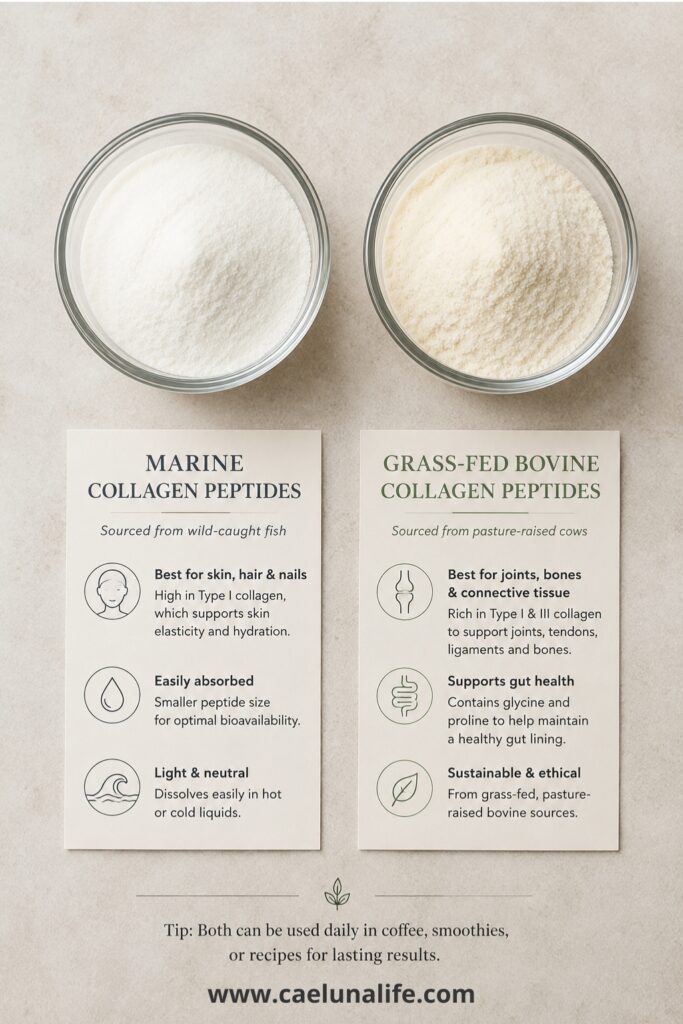
Different collagen types predominate in different tissues. Type I is the primary structural collagen in skin, bones, tendons, and ligaments. Type III often appears with type I in skin and blood vessels. Type II is the primary collagen of articular cartilage. Most marine and bovine products provide predominantly type I with some type III — making them appropriate for skin, nails, and hair goals. For joint-specific concerns, look for either undenatured type II collagen (a distinct product, typically at 40 mg daily) or a chicken-derived type II collagen hydrolysate.
Principle 3: Source Quality Matters
The source animal matters more than most marketing suggests. Grass-fed, pasture-raised bovine and wild-caught marine sources are generally preferable for purity and amino acid profile. Cheap, commodity-grade collagen from industrial farming has been repeatedly shown in consumer testing to contain measurable heavy metal contamination and antibiotic residues. For a product you plan to take daily for years, paying the premium for certified-source products is justified.
Principle 4: Pair with Vitamin C
Vitamin C is a required cofactor for collagen synthesis. Every clinical trial in this space has been conducted in subjects with adequate vitamin C status, and several have specifically co-supplemented vitamin C. If your diet is low in vitamin C (fewer than two servings of citrus, berries, peppers, or leafy greens per day), adding 500 mg of vitamin C alongside your daily peptide dose is reasonable. Some products now include vitamin C in the formulation for this reason.
Collagen Supplements After 40 — The Formats
Unflavoured Powder (The Default)
Unflavoured hydrolysed collagen peptide powder is the most versatile and cost-effective format available. It dissolves easily in coffee, tea, smoothies, or oatmeal, has a neutral taste, and is the format used in the majority of clinical trials. A 300–400 g tub typically lasts 30–40 days at 10 g daily and costs £20–£35 for a quality product. This is the format most women settle on for long-term use.
Flavoured Powders
Flavoured versions — typically vanilla, chocolate, or berry — have become popular as coffee creamers or shake bases. The trade-off is that flavoured products usually contain added sweeteners (natural or artificial), which some women prefer to avoid. If you do choose a flavoured product, check the sweetener: stevia and monk fruit are generally benign; maltodextrin or sucralose are worth avoiding if you want the cleanest possible product.
Liquid Collagen and Ready-to-Drink
Pre-mixed liquid collagen products sell at a significant premium for no meaningful advantage over powder — and often come with added sugars or preservatives. Skip these unless a very specific convenience case justifies the cost.
Capsules
Capsule form is a poor choice simply because of dose: you need 10 g daily, and capsules typically contain 500 mg each. That means twenty capsules per day. The dose is unachievable in capsule form for most people. Powder or liquid is the practical format.
Bone Broth
Home-made bone broth from high-quality bones is a legitimate source of collagen-related amino acids. It does not typically deliver the specific short-chain hydrolysed peptides that drive the fibroblast-signalling effect, but it provides amino acid substrate, glycine, and comfort. Bone broth and peptide powder are complements, not substitutes.
🛒 Recommended: Marine Collagen Peptides — Unflavoured, 454g — The format and source of collagen supplements most often used successfully by women over 40 for skin and joint support.
How to Take Collagen Supplements After 40
The Right Dose
The evidence-based effective dose is 10 grams daily of hydrolysed collagen peptides for skin and general connective tissue goals. Some trials have used as little as 2.5 g and shown effect; others have used up to 20 g. For women over 40, 10 g daily is the sweet spot — well within the range that has shown effect in RCTs, sufficient to provide meaningful amino acid substrate, and affordable on a monthly basis. For specifically joint-focused use of undenatured type II collagen, the dose is different: 40 mg daily of the UC-II specific form.
The Right Timing
There is no strong evidence that timing substantially affects efficacy. Some practitioners suggest morning dosing to provide collagen amino acids early in the day; others suggest post-workout to support tendon and connective tissue adaptation; others suggest evening to coincide with overnight repair processes. Any of these is reasonable. The single most important timing rule is consistency — 10 g daily, same time, every day — because the fibroblast stimulation is cumulative and the clinical effect requires 8–12 weeks of continuous dosing to become visible.
The Right Expectations
Collagen supplements after 40 do not produce dramatic cosmetic transformations. Realistic expectations: after 8–12 weeks of daily use, many women notice slight improvements in skin feel, reduced dryness in the hands and around the eyes, modestly less joint stiffness on getting up from a chair, and nails that break less frequently. These are meaningful quality-of-life wins but not visible transformations. If you expect a filler-like effect on wrinkles, you will be disappointed. The benefits of collagen supplements are quieter and cumulative.
How Long to Take Them
The clinical trials that demonstrate benefit have run for 8–24 weeks. Beyond 24 weeks, the research thins, but there is no known reason to stop or cycle daily peptide use as long as you continue to benefit. Many women use them continuously for years. As with all supplementation, periodically reassessing whether a product is still earning its place in your routine is sensible — if after six months you cannot point to a specific benefit, that bottle can probably be dropped.
Collagen Supplements After 40 — What to Pair With for Better Results

Collagen supplements work best as part of a broader skin and connective tissue strategy — not in isolation. The companions that meaningfully amplify results:
- Vitamin C (500–1000 mg daily): required cofactor for collagen synthesis. Without it, the amino acid substrate from the peptide dose is underused.
- Dietary protein (1.2–1.6 g/kg body weight): adequate baseline protein supports all collagen biology. Peptide supplementation works on top of a protein-adequate diet, not as a substitute.
- Vitamin A (retinol form or sufficient beta-carotene intake): supports epidermal turnover and skin cell function that works alongside dermal collagen.
- Zinc (8–15 mg daily from food or supplement): required for wound healing and epidermal structure.
- Silica (from whole oats, leafy greens, or a horsetail-derived supplement): supports connective tissue architecture, though the evidence is thinner than for the above.
- Sun protection (SPF 30+ daily): the single most impactful skin intervention. UV damage degrades collagen far faster than peptide supplementation can rebuild it.
- Resistance training: loading of tendons and ligaments stimulates local collagen synthesis in connective tissue where mechanical demand increases fibroblast activity.
- Sleep quality: the overnight growth hormone pulse is when much of the body’s collagen synthesis happens. Chronic sleep deprivation undermines the benefit of any peptide regimen significantly.
Collagen Supplements After 40 — Who Should Be Cautious
Collagen supplements are generally safe, but a few groups should think twice or consult a clinician:
- Women with kidney disease: collagen is a protein, and protein load matters in impaired kidney function. Discuss any supplement protein with your nephrologist.
- Women with allergies to the source animal: marine collagen supplements are inappropriate for people with fish or shellfish allergies. Bovine collagen is inappropriate for those with specific beef sensitivities. Chicken-derived type II collagen is inappropriate for egg or chicken allergies. Check sourcing carefully.
- Women following strict vegetarian or vegan diets: no collagen supplements are currently vegan — collagen is an animal-sourced protein by definition. Vegetable-based “collagen boosters” are vitamin and amino acid blends designed to support endogenous collagen synthesis; they are not collagen itself. Honest labelling matters here.
- Women with specific histamine intolerance: some hydrolysed collagen products can trigger histamine reactions. If you experience flushing, headaches, or gut symptoms after starting a peptide supplement, this is worth investigating.
- Pregnant or breastfeeding women: most collagen supplements are considered safe, but the clinical trial evidence specifically in pregnancy is limited. Consult your clinician.
Collagen Supplements After 40 — Making It a Sustainable Habit
The biggest predictor of whether collagen supplements deliver benefit is not the product you choose — it is whether you actually take it every day for three months. The scoop on the counter that sat unused for six weeks produces no effect. Several practical strategies that women in their forties have used to make this genuinely stick:
- Habit-stack with coffee. The easiest routine is to add 10 g of unflavoured collagen peptides to the first coffee of the day. Collagen dissolves cleanly in hot liquid, the flavour is negligible, and the coffee ritual is itself already habitual — you are not adding a new habit, just layering onto an old one.
- Keep the scoop in the bag. Store the measuring scoop inside the collagen supplements container permanently. Removing the small step of finding a scoop increases daily compliance noticeably.
- Pair with a visible daily cue. Keep the container on the countertop, not hidden in a cupboard. The visual cue matters for the first few weeks until the habit takes hold.
- Track 90 days, then reassess. The clinical trials that showed benefit ran for roughly 12 weeks. Commit to 90 days of consistent dosing, take a clear “before” photo, and reassess at the end. This makes the investment intentional rather than indefinite and gives you a genuine before-and-after to judge by.
- Build in a travel bottle. A small empty 250 ml container refilled with 10–14 days of pre-measured collagen peptides lives permanently in your travel bag. Travel is the single most common reason for breaks in supplement routines, and a pre-loaded travel container eliminates 90% of the issue.
- Separate the collagen spend from household groceries. Keep a mental or actual budget line for collagen supplements as a health expense, not a grocery item. Treating it as a deliberate line item rather than an impulse top-up means you will only keep buying it if you are actually using and benefiting from it.
Frequently Asked Questions About Collagen Supplements After 40
How long until I see results from collagen supplements?
The clinical trials showing benefit have typically run for 8–12 weeks before measurable changes in skin elasticity, hydration, and joint comfort appeared. Nail and hair changes often take 16–24 weeks because these tissues grow slowly. If you have been taking a peptide supplement consistently at 10 g daily for four months with no subjective benefit, the product may not be effective for you, the dose may be too low, or the issue you are trying to address may not be primarily a collagen problem.
Can men take collagen supplements too?
Yes. The collagen biology being addressed is not sex-specific. Men over 40 experience the same collagen decline as women, though typically less accelerated because they do not experience the menopausal drop. Every clinical trial in this space has included men, and the effects are comparable. The framing as a “women’s supplement” is a marketing choice, not a biological truth.
Do collagen supplements cause weight gain?
No. 10 g of collagen peptides contributes roughly 40 calories per serving — a trivial amount that does not meaningfully affect weight. If you have gained weight while using a peptide product, the cause is elsewhere (diet, sleep, perimenopausal changes, activity level). These products are among the most calorie-efficient supplements you can take.
Are marine or bovine collagen supplements better?
Both are effective. Marine versions (derived from fish skin or scales) tend to have slightly smaller peptide sizes and may be marginally better absorbed, though clinical comparisons have not shown a meaningful difference in outcomes. Marine is slightly more expensive and has a subtly different amino acid profile (more glycine-proline-hydroxyproline triplets). Bovine is less expensive, more sustainable in many contexts, and equally well-supported by clinical trials. Choose based on your source-ethics preferences, allergy profile, and budget.
Can I get the same effect from eating more meat or bone broth?
Partially. Eating more protein generally, including gelatinous cuts of meat and well-made bone broth, will provide collagen amino acids. But the specific bioactive dipeptides that drive the fibroblast-signalling effect — hydroxyproline-glycine and hydroxyproline-proline — are formed specifically through enzymatic hydrolysis and are present at higher concentrations in hydrolysed peptide powders than in food sources. For a food-first approach, bone broth plus protein-adequate meals is reasonable. For women who want the specific signalling effect, collagen supplements deliver it more reliably and at a more consistent dose.
Can I take collagen supplements with other supplements?
Yes. These products have no known negative interactions with the common supplements in a women-over-40 stack — vitamin D, magnesium, omega-3, creatine, multivitamin, probiotics. Taking collagen with vitamin C is actively beneficial because of the shared collagen synthesis pathway. Some women add collagen directly to a morning smoothie that also contains protein powder; there is no conflict in doing so.
Is collagen the best use of my supplement budget?
This is the right question. For a woman with tight budget and no specific skin or joint complaint, a peptide powder is probably not the highest-value first purchase — vitamin D3, magnesium glycinate, and omega-3 would come first. For a woman specifically concerned with skin ageing, joint comfort, or brittle nails, collagen supplements are a genuinely evidence-supported addition that earns its £25–£35 per month. Prioritise the foundational supplements first, then layer in collagen if it addresses a specific concern.
Related Articles
These guides connect directly with what you have just read:
- Best Supplements for Women Over 40 — What Actually Works — Where collagen supplements fit in the broader supplement stack for women in this decade.
- My Daily Supplement Routine at 44 — What I Take and Exactly Why — A realistic real-world routine including collagen supplements as part of a layered approach.
- Magnesium for Women Over 40 — Which Type Actually Works and Why — The other most commonly layered supplement alongside collagen for women in this decade.
- Supplements for Perimenopause — What Helps and What Is Just Hype — How collagen supplements fit into a broader perimenopause-era supplement plan.
- Best Anti-Inflammatory Foods to Add to Your Diet After 40 — The dietary companion to collagen supplements for women over 40 focused on skin and joint health.